

Human GBP-2 / GBP2 Protein (His Tag)
GBP2
- 100ug (NPP2155) Please inquiry
| Catalog Number | P13930-H08H |
|---|---|
| Organism Species | Human |
| Host | Human Cells |
| Synonyms | GBP2 |
| Molecular Weight | The recombinant human GBP2 consists of 599 amino acids and predicts a molecular mass of 68.3 KDa. It migrates as an approximately 62 KDa band in SDS-PAGE under reducing conditions. |
| predicted N | Met |
| SDS-PAGE | 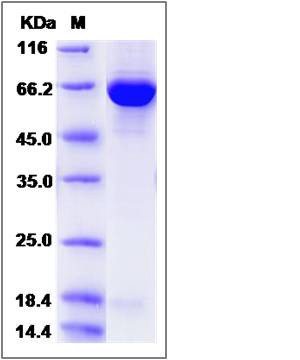 |
| Purity | > 90 % as determined by SDS-PAGE |
| Protein Construction | A DNA sequence encoding the human GBP2 (AAH73163.1) (Met1-Cys588) was expressed with a polyhistidine tag at the C-terminus. |
| Bio-activity | |
| Research Area | Signaling |Signal Transduction |Second Messenger |Nucleotide Messenger |GTP |
| Formulation | Lyophilized from sterile PBS, pH 7.4 1. Normally 5 % - 8 % trehalose, mannitol and 0.01% Tween80 are added as protectants before lyophilization. Specific concentrations are included in the hardcopy of COA. |
| Background | GBP-2 belongs to the guanylate-binding protein (GBP) family. GBPs are characterized by their ability to specifically bind guanine nucleotides (GMP, GDP, and GTP). As GTPases induced by IFN-gamma (Interferon-inducible GTPase), they are key to the protective immunity against microbial and viral pathogens. GBP-2 is a GTPase that converts GTP to GDP and GMP. It binds GTP, GDP and GMP. GBP-2 hydrolyzes GTP very efficiently. GDP rather than GMP is the major reaction product. GBP-2 is induced by interferons that have antiviral effects and inhibit tumor cell proliferation. |
| Reference |