

Human GDF-15 Protein (Fc Tag)
GDF-15,MIC-1,MIC1,NAG-1,PDF,PLAB,PTGFB
- 100ug (NPP1297) Please inquiry
| Catalog Number | P10936-H01H |
|---|---|
| Organism Species | Human |
| Host | Human Cells |
| Synonyms | GDF-15,MIC-1,MIC1,NAG-1,PDF,PLAB,PTGFB |
| Molecular Weight | The recombinant human Fc/GDF15 is a disulfide-linked homodimeric protein. The reduced monomer consists of 370 amino acids and has a predicted molecular mass of 40.6 kDa. rhGDF15/Fc monomer migrates as an approximately 44 kDa protein in SDS-PAGE under reducing conditions. |
| predicted N | Glu 20 |
| SDS-PAGE | 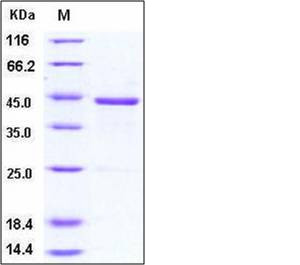 |
| Purity | > 95 % as determined by SDS-PAGE |
| Protein Construction | A DNA sequence encoding the mature form of human GDF15 (NP_004855.2) (Ala 197-Ile 308) was expressed with the fused Fc region of human IgG1 at the N-terminus. |
| Bio-activity | |
| Research Area | Cancer |Signal transduction |Growth Factor & Receptor |Hormones |
| Formulation | Lyophilized from sterile 100mM Glycine, 10mM NaCl, 50mM Tris, pH 7.5 1. Normally 5 % - 8 % trehalose, mannitol and 0.01% Tween80 are added as protectants before lyophilization. Specific concentrations are included in the hardcopy of COA. |
| Background | Growth-differentiation factor 15 (GDF15), also known as MIC-1, is a secreted member of the transforming growth factor (TGF)-β superfamily, as a novel antihypertrophic regulatory factor in the heart. GDF-15 / GDF15 is not expressed in the normal adult heart but is induced in response to conditions that promote hypertrophy and dilated cardiomyopathy and it is expressed highly in liver. GDF-15 / GDF15 has a role in regulating inflammatory and apoptotic pathways in injured tissues and during disease processes. GDF-15 / GDF15 is synthesized as precursor molecules that are processed at a dibasic cleavage site to release C-terminal domains containing a characteristic motif of 7 conserved cysteines in the mature protein. GDF-15 / GDF15 overexpression arising from an expanded erythroid compartment contributes to iron overload in thalassemia syndromes by inhibiting hepcidin expression. |
| Reference |