

Human IBA1 / AIF1 Protein (His Tag)
AIF-1,IBA1,IRT-1,IRT1
- 100ug (NPP2257) Please inquiry
| Catalog Number | P14227-H07E |
|---|---|
| Organism Species | Human |
| Host | E. coli |
| Synonyms | AIF-1,IBA1,IRT-1,IRT1 |
| Molecular Weight | The recombinant human AIF1 consists of 162 amino acids and predicts a molecular mass of 18.5 KDa. It migrates as an approximately 18 KDa band in SDS-PAGE under reducing conditions. |
| predicted N | His |
| SDS-PAGE | 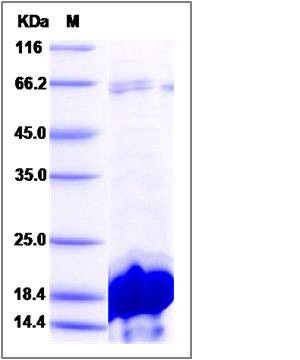 |
| Purity | > 85 % as determined by SDS-PAGE |
| Protein Construction | A DNA sequence encoding the mature form of human AIF1 (P55008-1) (Met1-Pro147) was expressed with a polyhistide tag at the N-terminus. |
| Bio-activity | |
| Research Area | Cell Biology |Cell Cycle |Oxidative Stress |
| Formulation | Lyophilized from sterile PBS, 10% glycerol, pH 7.4 1. Normally 5 % - 8 % trehalose and mannitol are added as protectants before lyophilization. Specific concentrations are included in the hardcopy of COA. |
| Background | AIF1, also known as IBA1, is an actin-binding protein. AIF1 is expressed selectively in human macrophage-like cell lines, and in a subset of CD68(+) macrophages in the interstitial and perivascular spaces of human heart allografts. It is expressed in macrophages and neutrophils. AIF1 enhances membrane ruffling and RAC activation. AIF1 enhances the actin-bundling activity of LCP1. It also enhances lymphocyte migration. AIF1 may play a role in macrophage activation and function. It binds calcium and plays a role in RAC signaling and in phagocytosis. It promotes the proliferation of vascular smooth muscle cells and of T-lymphocytes. |
| Reference |