

Human LILRB2 / ILT4 / LIR-2 Protein (Fc Tag)
CD85D,ILT-4,ILT4,LIR-2,LIR2,MIR-10,MIR10
- 100ug (NPP2310) Please inquiry
| Catalog Number | P14132-H02H |
|---|---|
| Organism Species | Human |
| Host | Human Cells |
| Synonyms | CD85D,ILT-4,ILT4,LIR-2,LIR2,MIR-10,MIR10 |
| Molecular Weight | The recombinant human LILRB2/Fc is a disulfide-linked homodimer. The reduced monomer comprises 681 amino acids and has a predicted molecular mass of 74.8 kDa. The apparent molecular mass of the protein is approximately 93 kDa in SDS-PAGE under reducing conditions. |
| predicted N | Gln 22 |
| SDS-PAGE | 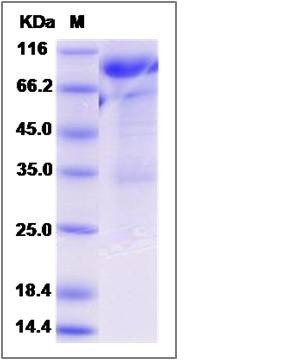 |
| Purity | > 85 % as determined by SDS-PAGE |
| Protein Construction | A DNA sequence encoding the human LILRB2 (AAH36827.1) (Met1-Val461) was expressed with the Fc region of human IgG1 at the C-terminus. |
| Bio-activity | Measured by its ability to support the adhesion of HSB2 human peripheral blood acute lymphoblastic leukemia cells. When 8 x 10E4 cells/well are added to LILRB2-coated plates (4.4 μg/mL with 100 μL/well), approximately >45% cells will adhere after 1 hour at 37℃. |
| Research Area | Immunology |Adaptive Immunity |Major Histocompatibility Complex (MHC) |MHC Class I |
| Formulation | Lyophilized from sterile PBS, pH 7.4. 1. Normally 5 % - 8 % trehalose and mannitol are added as protectants before lyophilization. Specific concentrations are included in the hardcopy of COA. |
| Background | ILT4, also known as LILRB2, is a member of the the subfamily B class of LIR receptors which contain two or four extracellular immunoglobulin domains, a transmembrane domain, and two to four cytoplasmic immunoreceptor tyrosine-based inhibitory motifs (ITIMs). ILT4 gene is a member of the leukocyte immunoglobulin-like receptor (LIR) family. Multiple transcript variants encoding different isoforms have been found for ILT4 gene. ILT4 is expressed on immune cells where it binds to MHC class I molecules on antigen-presenting cells and transduces a negative signal that inhibits stimulation of an immune response. It is thought to control inflammatory responses and cytotoxicity to help focus the immune response and limit autoreactivity. |
| Reference |