

Human S100A2 Protein
CAN19,S100L
- 100ug (NPP2476) Please inquiry
| Catalog Number | P10180-HNAE |
|---|---|
| Organism Species | Human |
| Host | E. coli |
| Synonyms | CAN19,S100L |
| Molecular Weight | The recombinant human S100A2 consists of 97 amino acids and has a predicted molecular mass of 11 kDa. |
| predicted N | Met 2 |
| SDS-PAGE | 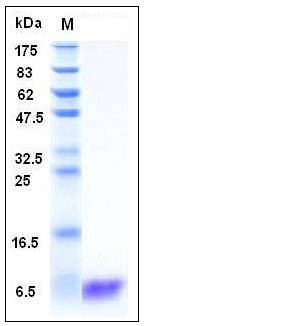 |
| Purity | > 95 % as determined by SDS-PAGE |
| Protein Construction | A DNA sequence encoding the human S100A2 (NP_005969.1) (Met 2-Pro 98) was expressed. |
| Bio-activity | |
| Research Area | Cell Biology |Cell Cycle |Cell Differentiation |
| Formulation | Lyophilized from sterile PBS, pH 7.4 1. Normally 5 % - 8 % trehalose, mannitol and 0.01% Tween80 are added as protectants before lyophilization. Specific concentrations are included in the hardcopy of COA. |
| Background | The calcium-binding Protein S100A2 is a member of the S100 family of proteins containing 2 EF-hand calcium-binding motifs. S100 family genes are located as a cluster on chromosome 1q21, and S100 proteins consisting of at least 20 members are involved in the regulation of a number of cellular processes such as cell-cycle progression and cell differentiation. S100A2 was first detected in lung and kidney, and is mainly expressed in a subset of tissues and cells such as breast epithelia and liver. The S100A2 protein is a homodimer that undergoes a conformational change upon binding of calcium, and the active form functions in regulating cell proliferation and differentiation, gene transcription, and p53-dependent growth arrest and apoptosis. Accordingly, this protein is regarded as a putative tumor suppressor, and thus chromosomal rearrangements and reduced expression of S100A2 gene have been implicated in certain carcinomas. |
| Reference |