

Human UBE2M Protein
hUbc12,UBC-RS2,UBC12
- 100ug (NPP4366) Please inquiry
| Catalog Number | P13203-HNCE |
|---|---|
| Organism Species | Human |
| Host | E. coli |
| Synonyms | hUbc12,UBC-RS2,UBC12 |
| Molecular Weight | The recombinant human UBE2M consists of 185 amino acids and has a calculated molecular mass of 21 kDa. It migrates as an approximately 20 kDa band in SDS-PAGE under reducing conditions. |
| predicted N | Gly |
| SDS-PAGE | 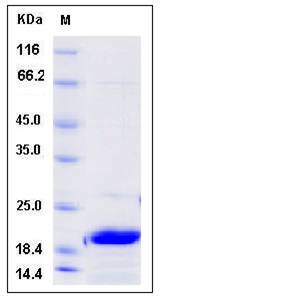 |
| Purity | > 90 % as determined by SDS-PAGE |
| Protein Construction | A DNA sequence encoding the human UBE2M (P61081) (Met 1-Lys 183) was expressed and purified, with additional two amino acids (Gly & Pro) at the N-terminus. |
| Bio-activity | |
| Research Area | Epigenetics |Histone Modifying Enzymes |Ubiquitylation |Ubiquitin like Modifiers |
| Formulation | Lyophilized from sterile PBS, 10% glycerol, 1mM DTT, pH 8.0 1. Normally 5 % - 8 % trehalose and mannitol are added as protectants before lyophilization. Specific concentrations are included in the hardcopy of COA. |
| Background | UBE2M is a member of the ubiquitin-conjugating E2 family whose members perform the second step in the ubiquitination reaction. Initially identified as the main process for protein degradation, ubiquitination is believed nowadays to be crucial for a wider range of cellular processes. The outcome of the ubiquitin-conjugation reaction, and thereby the fate of the substrate, is heavily dependent on the number of ubiquitin molecules attached and how these ubiquitin molecules are inter-connected. To deal with this complexity and to allow adequate ubiquitination in time and space, a highly sophisticated conjugation machinery has been developed. In a sequential manner, ubiquitin becomes activated by an ubiquitin-activating enzyme (E1), which then transfers the ubiquitin to a group of ubiquitin-conjugating enzymes (E2s). Next, ubiquitin-loaded E2s are interacting with ubiquitin protein ligases (E3s) and ubiquitin is conjugated to substrates on recruitment by the E3. These three key enzymes are operating in a hierarchical system, wherein two E1s and 35 E2s have been found and hundreds of E3s have been identified in humans. |
| Reference |