

Rat Thrombomodulin / THBD Protein (His Tag)
THBD
- 100ug (NPP2881) Please inquiry
| Catalog Number | P80348-R08H |
|---|---|
| Organism Species | Rat |
| Host | Human Cells |
| Synonyms | THBD |
| Molecular Weight | The recombinant rat THBD comprises 512 amino acids and predicts a molecular mass of 55.2 kDa. The apparent molecular mass of the recombinant protein is approximately 95 kDa in SDS-PAGE under reducing conditions due to glycosylation. |
| predicted N | Ile 17 |
| SDS-PAGE | 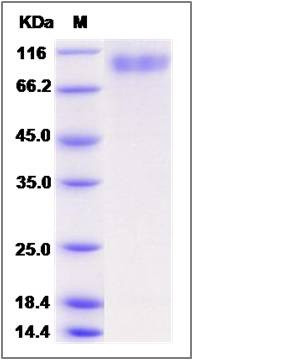 |
| Purity | > 90 % as determined by SDS-PAGE |
| Protein Construction | A DNA sequence encoding the rat THBD (O35370) (Met1-Ser517) was expressed with a polyhistidine tag at the C-terminus. |
| Bio-activity | |
| Research Area | Epigenetics |RNAi |Dicer |
| Formulation | Lyophilized from sterile PBS, pH 7.4 1. Normally 5 % - 8 % trehalose and mannitol are added as protectants before lyophilization. Specific concentrations are included in the hardcopy of COA. |
| Background | Thrombomodulin, also known as THBD(CD141), is an integral membrane protein which reduces blood coagulation by converting thrombin to an anticoagulant enzyme from a procoagulant enzyme. Thrombomodulin is expressed on the surface of endothelial cells and serves as a cofactor for thrombin. It is also expressed on human mesothelial cell, monocyte and a dendritic cell subset. Thrombomodulin functions as a cofactor in the thrombin-induced activation of protein C in the anticoagulant pathway by forming a 1:1 stoichiometric complex with thrombin. Thrombomodulin also regulates C3b inactivation by factor I. Mutations in the thrombomodulin gene have also been reported to be associated with atypical hemolytic-uremic syndrome. |
| Reference |